A cold shower in Nadarzyn. What I heard about digitisation at the trade fair
On LinkedIn, we talk about AI agents and automation. Then you go to a trade fair and hear that a salesperson visiting a customer has to call head office to check what is in stock.
- Goal
- Ask companies about problems in their day-to-day work and where AR, automation, and AI could help.
- Tools
Conversations at stands and my own notes. AR and AI were subjects of the conversations.
- Process
- Three questions: what is hard to solve, whether you are discussing new technologies, and who to continue the conversation with.
- Result
- Specific situations: a call to check stock, launching an online store, and different expectations of AR.
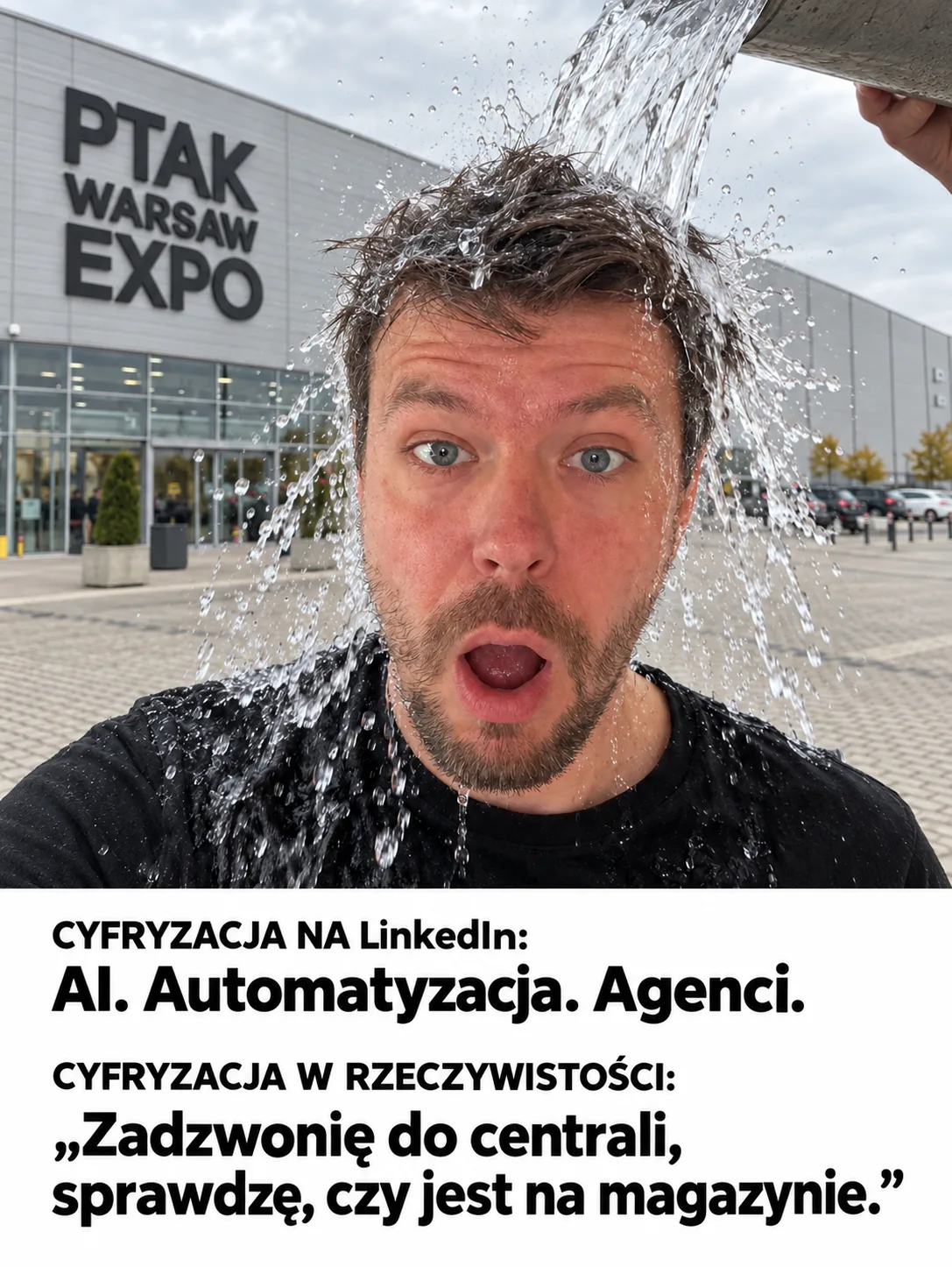
That was the cold shower I got at Warsaw Home in Nadarzyn. It challenged my own idea of what companies need today.
I was there on 21 October. Warsaw Home & Contract at Ptak Warsaw Expo is about furniture, kitchens, bathrooms, lighting, and interior materials. Manufacturers, distributors, salespeople, and architects. In the public catalogue, I found 628 exhibitor profiles. Plenty of opportunities to step outside conversations about technology with people who also work with technology every day. Event catalogue.
I had three questions:
- What is difficult for you to solve in the company or the industry today?
- Are you talking about AR, automation, and AI?
- Who in the company is worth continuing this conversation with?
Below are a few situations that have stayed with me. No names or company names. The quotations reflect the meaning of my notes; they are not verbatim transcripts.
“When I am with a customer, I cannot see what is in stock. I have to call head office.”
We were talking about an AR app, meaning one that shows a product in augmented reality. What emerged instead was a problem with product availability.
A salesperson is with a customer. They need to know whether the product is in stock. To get an answer, they call head office.
This was the strongest moment of those conversations for me. I arrive with ideas for new technologies, while the person I am speaking to needs information that lets them serve a customer.
I would like to see what this looks like in practice: how often they have to call, how long they wait for an answer, and why they cannot check it themselves. Perhaps the data is in the system but they cannot access it from a phone. Perhaps the issue is how current it is. I do not know that yet. But I do know where to begin the next conversation.
“We are only just launching an online store.”
At another company, there had only been a website until now. Now they are building a store.
It is easy to think: only just? Especially when you read every day about further AI possibilities. But I do not know their production or warehouse systems. The lack of an online store gives me no basis for judging the whole company.
I am interested in the specifics: what will the customer be able to handle themselves? Place an order, check availability, repeat a purchase? And how many calls or messages will that save employees? That is what I would like to find out.
“You are already the fifth company to come to us with AR.”
That was also a useful answer. The subject is familiar. Showing a product on a phone screen is no longer new to this person.
The person I spoke with pointed out something very practical. With a large, expensive product, a customer wants to see its real colour, touch the material, and check how it looks in the light.
I understand that. A visualisation can help assess size and placement. The final choice of colour or finish may still require a sample or a visit to a showroom.
I take one question from that conversation into the next meeting: what happened to the previous AR proposals? What was useful, what was missing, and was any idea implemented? The fact that someone has heard about it before is too little to know the answer.
An architect, meanwhile, pointed to a use case for herself: a 3D view including the ceiling and the placement of ventilation, together with AR measurements.
There is immediately something to discuss. We can take a specific project, look at the current way of working, and check whether such a tool actually makes anything easier. That interest is worth verifying further with an example from her work.
That is why I also asked who to speak with in the company. The person at the stand may know the problem well. For a further conversation, we will also need someone responsible for the process in question and able to decide on a change.
For context: according to Statistics Poland, in 2026 AI is used by 17.8% of enterprises covered by the survey. These are national data. My conversations are a few examples from the trade fair, not a study of the whole industry. Statistics Poland, 21.10.2026.
One more practical conclusion: it is worth taking an offline demo to a trade fair. Downloaded models, screenshots, and a short recording. Internet access in an exhibition hall can quickly put a presentation to the test. It would be a shame to lose a good conversation while waiting for something to load.
What has stayed with me most, though, is that call to head office. If I want to help a company, I first need to understand why the salesperson still has to make it.