
Online store analysis and recommendations
A friend asked what he could improve in his shop. With AI, we looked at the offer, competitors and sales channels. The most interesting question turned out to be: what is worth testing before we spend money?
- Goal
- Help a shop owner choose low-cost actions and determine what their profitability depends on.
- Tools
Codex · web search and browser · public pages of the shop, competitors and sales platforms · PDF report
- Process
- Owner's need → review of the shop and market → comparison of options → cost model → small test and 90-day plan.
- Result
- An eight-page report with observations, recommendations and numerical scenarios. The effects of implementation and sales remain to be checked.
A friend asked for my help with his shop, Coin24, which sells coins, banknotes and collecting accessories. What could be improved on the site? How could it reach customers better? Perhaps list products on Etsy? I wanted to help him choose specific actions so that he would spend little and get as much as possible from it.
I brought this task to Codex. I asked it to analyse the shop, competitors, ways to reach customers and possible outcomes. I wanted concise guidance supported by numbers.
We worked on an existing shop. This example is also useful when developing a new business: you need to turn an idea into questions, check the market and calculate what would have to happen for the venture to make sense.
Start with the decision question
“Come up with ways to increase sales” can produce a long list: ads, social media, a newsletter, a new site. But where should you start, and why there?
In my brief, the important constraints were low cost, specific guidance and a possible outcome. That meant the analysis was meant to lead to choosing the order of actions. Should the offer first be improved in the shop itself, or should customers be sought on another platform?
AI helped gather information and compare options. Ultimately, the owner needs to assess whether the recommendations fit his stock, margin and the time available to handle orders.
What the shop review showed
The review on 4 October 2026 covered public pages, selected products and categories, the mobile view, and technical elements. It also checked SEO, meaning how a site is prepared so that a search engine can understand its content and show it for relevant queries.
One specific finding: in the checked promotions and new-arrivals modules, 7 of 32 unique products were marked unavailable. That is about 22% of that sample. Two appeared among the first four promotions. The finding concerns this part of the site on the day of the analysis, not the whole inventory or the shop's state today.
That led to a straightforward recommendation: first, better highlight products that can be bought. The report also raised points about making delivery costs and set contents clear, and about an inconsistent description of a coin's year. These are specific places for the owner to check before paying for additional visits.
The analysis also identified existing assets: guides, detailed product pages and a newsletter. The proposed first step covered three categories and twenty available products. The report did not provide sufficient grounds for a full redesign of the shop.
Market research should lead to a hypothesis
Research simply means gathering and checking information. Here, it included comparing competitors' offers, selected prices, ways of presenting goods and possible sales channels.
Three price comparisons did not justify the conclusion that the entire shop was too expensive. For one product, the offer was cheaper than the competitor offer used for comparison; for another, the situation was the opposite. An item's condition, extras and delivery also mattered. Price alone, without that context, settles little.
The same applies to the question “where are the customers?” The range of products made it possible to identify several potential needs:
| Customer need | Hypothesis to check |
|---|---|
| Complete a particular year or series | A precise description and availability may matter more than broad advertising for the shop. |
| Choose protection for a coin they already own | A size chart and matching accessories may make a purchase easier. |
| Buy a gift for a collector | A set with a clear description of its contents may help someone who does not know the subject well. |
These are proposals derived from the offer, not researched customer profiles. They can later be checked against enquiries to the shop, conversations with buyers and actual orders.
Etsy also came up. The report treated it as a narrow, later experiment for suitably selected items. First, it would be necessary to check whether the offer fits the platform's rules, all costs and the time needed to handle orders. The presence of customers on a given platform alone does not say whether our offer will be profitable there.
What AI could not read from the site
I also asked for competitors' traffic and the search terms through which people find their shops. It was not possible to obtain reliable, comparable visitor numbers or monthly search volumes. Search results helped find competitors, but they were not a measurement of the shop's position in Google.
This is an important boundary. A public site cannot reveal the actual margin, conversion rate or campaign result. Conversion here means the proportion of visits that end in an order. Further assessment would require the owner's data: orders and costs, Google Analytics to analyse traffic, and Search Console to check visibility in search.
We did not have those data in this work. That is why the figures describing a possible outcome went into an explicit model with assumptions.
Will higher sales leave any money behind?
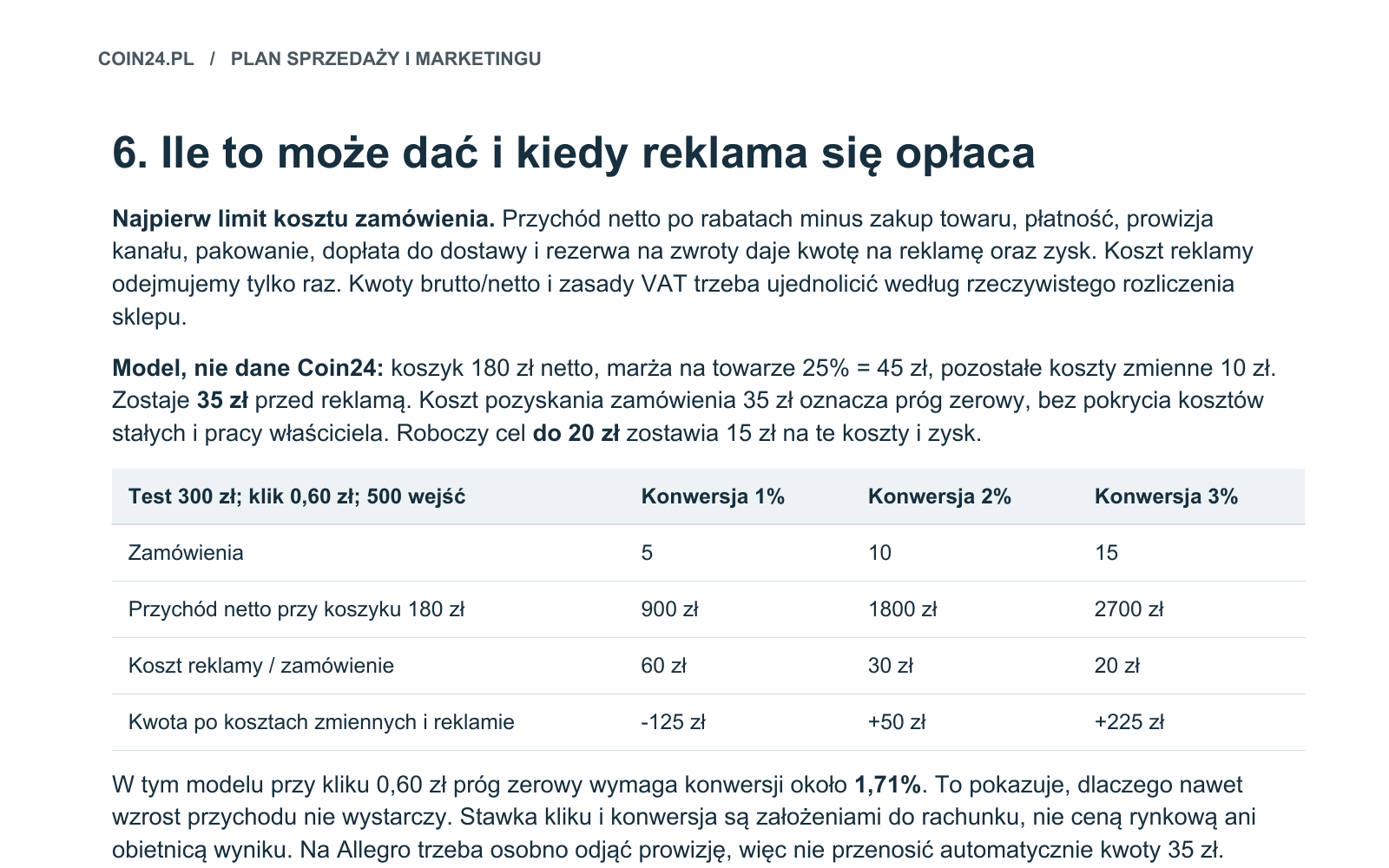
The report included a simple calculation. This is a calculation example, not Coin24 financial data or a forecast. It assumed a net basket value of PLN 180, a 25% product margin and PLN 10 in other variable costs per order. That leaves PLN 35 before advertising, fixed costs and the owner's work.
The next assumptions were PLN 300 for advertising and PLN 0.60 per click, which means 500 visits. The click price is assumed for the example, not established through market research.
| In the same model | Conversion rate 1% | Conversion rate 2% | Conversion rate 3% |
|---|---|---|---|
| Orders from 500 visits | 5 | 10 | 15 |
| Net revenue | PLN 900 | PLN 1,800 | PLN 2,700 |
| Advertising cost per order | PLN 60 | PLN 30 | PLN 20 |
| Amount after variable costs and advertising | −PLN 125 | +PLN 50 | +PLN 225 |
At 1%, there are orders and revenue, but the calculation ends in a loss. At 2%, PLN 50 remains, which must still cover fixed costs and work. Your own figures may look completely different—that is precisely why you need to substitute them before making a decision.
This is how AI can be used to validate an idea: ask it to change one assumption and see how the outcome changes. A lower margin, a more expensive click or an additional commission can reverse the conclusion. The calculations need checking, and the assumptions need comparing with data.
The analysis produced a 90-day plan
The outcome was an eight-page report: observations, competitors, channels for reaching customers, cost scenarios and the order of actions. The prepared PDF underwent an independent review. On that basis, I do not have confirmation that the recommendations were implemented or increased sales.
The direction was specific: improve the visibility of available products, calculate the amount remaining per order, and check one customer-acquisition channel. The plan also included conditions for stopping spending—for example, a lack of stock, a negative outcome after costs, or broken purchase measurement.
That is a useful result of such a conversation: you know what can be done, what it depends on and how to assess the trial.
How to use this for your own idea
For a new business, start with one specific person and need. Who has the problem, how do they solve it today, and what are they already paying for? Then look for existing alternatives and check how your offer would differ from them.
After the research, choose a small trial. It may be a few conversations with potential customers, offering one service, or testing a few products. A conversation will help you understand the need; an actual purchase gives a different, stronger signal of willingness to pay. A few conversations or transactions still do not prove demand across the whole market.
The prompt below is a proposal for your own work, prepared from this case:
Help me validate this idea: [description of the product or service].
Customer and their need: [who it is for and why].
Current solutions: [how the customer manages today].
I have available: [time, budget and resources].
Materials: [offer, site, notes or data that may be analysed].

Check existing alternatives and possible channels for reaching customers.
For important facts, give the source and date. Separate observations,
hypotheses, and figures assumed solely for calculations.
Do not make up traffic, market size, margin or sales results.

Identify the assumption that could change the decision the most.
Calculate a simple cautious and favourable scenario, showing the calculation
and missing costs. Propose one small test:
what we are checking, our time and spending limit,
what we measure, and when we stop or change the approach.
If key data are missing, indicate where to obtain them.
All right, what now? Choose one assumption on which the idea's viability depends, and check it at the lowest possible cost. AI can help prepare the research, comparison and calculation. The market's answer will only appear when you meet the customer and their decision.